
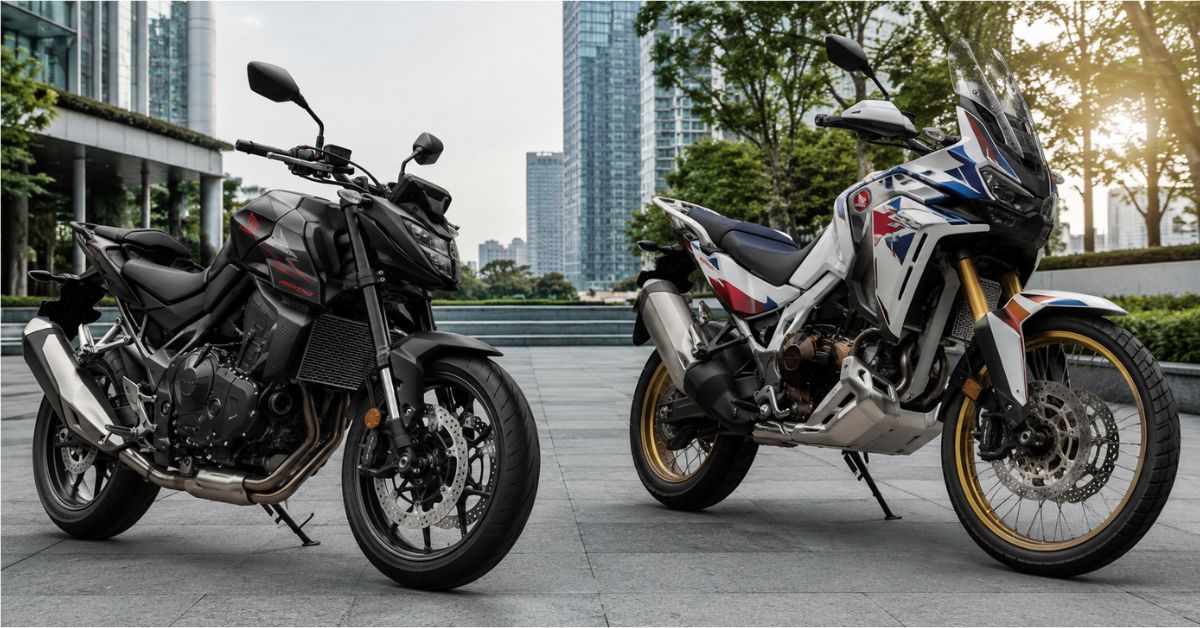
Honda has brought a big technology update to its premium motorcycle range in India. The new Honda 750 cc E-Clutch 2026 update mainly includes the CB750 Hornet E-Clutch and XL750 Transalp E-Clutch. Both motorcycles use Honda’s 755 cc parallel-twin engine and now come with the company’s E-Clutch technology.
The launch is significant because Honda is not only upgrading its premium bikes with new features but also bringing advanced clutch technology to the fore in India’s big-bike market. This update may be of interest to riders looking for performance, comfort and easier control in traffic.
What Happened?
Honda 750 cc E-Clutch 2026 Launched in India & Scooter India has introduced the 2026 CB750 Hornet E-Clutch and XL750 Transalp E-Clutch in India. These bikes bring Honda’s E-Clutch technology to the 755 cc platform.
The CB750 Hornet E-Clutch is a street naked motorcycle while the XL750 Transalp E-Clutch is an adventure touring motorcycle. Both are designed for different kinds of riders but share the same engine platform and the new E-Clutch feature.
The CB750 Hornet E-Clutch is priced at Rs 10.49 lakh and the XL750 Transalp E-Clutch is priced at Rs 13.20 lakh. These are showroom prices. Bookings are open at Honda’s premium dealer network.
What Is Honda E-Clutch?
Honda E-Clutch is not a fully automatic gearbox. This is an important point to understand.
The foot lever still shifts the rider through the gears. The difference is that it uses an electronic clutch operation. This means the rider can start, stop and change gears without the need of the clutch lever every time.
For example, when moving slowly in city traffic the rider does not have to constantly pull the clutch lever. The clutch is controlled automatically. But if the rider wants to operate the clutch lever manually, that option still exists.
This is not the same as Honda’s DCT system with E-Clutch. DCT can shift on its own, but E-Clutch keeps the feel of a manual bike, with less effort on the clutch.
Honda CB750 Hornet E-Clutch 2026: Key Details
The Honda CB750 Hornet E-Clutch is aimed at riders who want a sporty street bike with strong performance and modern electronics. It comes with a 755 cc parallel-twin engine that produces 67.5 kW of power and 75 Nm of torque.
The bike gets Showa 41 mm SFF-BP USD front forks, dual 296 mm front disc brakes, a 5-inch TFT display and Honda RoadSync connectivity. It also comes with multiple riding modes, which help the rider adjust the bike’s behavior according to road and weather conditions.
The biggest update is the E-Clutch system. For a naked street bike like the Hornet, this can make riding easier in Indian traffic while keeping the fun of manual gear changes alive.
Honda 750 cc E-Clutch 2026 Launched in India : Key Details
The Honda XL750 Transalp E-Clutch is made for touring and adventure riding. It also uses the same 755 cc parallel-twin engine, producing 67.5 kW and 75 Nm.
The Transalp gets features like Showa SFF-CA USD front suspension, a 5-inch TFT screen, Honda RoadSync, multiple riding modes and a Gravel mode. It is designed for riders who want to travel long distances and also handle rough roads.
The E-Clutch system can be useful on this bike because adventure touring often involves slow-speed control, traffic, hill roads and changing surfaces. The system may help reduce rider fatigue during long rides.
Why This Launch Matters for India
India’s premium motorcycle market is growing. Many riders are moving from 150 cc, 250 cc and 400 cc bikes to middleweight motorcycles. In this space, comfort and technology are becoming as important as power.
The Honda 750 cc E-Clutch 2026 range brings a new type of convenience to Indian riders. In big cities, heavy traffic can make clutch use tiring, especially on high-capacity motorcycles. E-Clutch can reduce this effort without removing the manual riding experience.
This also helps Honda create a stronger identity in the premium bike market. Instead of only focusing on engine power, Honda is trying to offer technology that changes the daily riding experience.
Price and Positioning in India
The CB750 Hornet E-Clutch is priced at Rs 10.49 lakh, ex-showroom. This places it in the premium middleweight naked bike space. It is not a budget motorcycle, but it offers a mix of performance, electronics and Honda’s new clutch technology.
The XL750 Transalp E-Clutch is priced at Rs 13.20 lakh, ex-showroom. This makes it a premium adventure tourer for riders who want long-distance comfort, off-road ability and modern features.
Both bikes are expected to attract buyers who want something more advanced than a regular manual motorcycle but do not want a fully automatic bike.
Engine and Performance
Both 750 cc Honda E-Clutch motorcycles use a 755 cc parallel-twin engine. This engine is known for strong mid-range performance and smooth power delivery. The 270-degree crank design gives it a character that feels more exciting than a basic twin-cylinder setup.
The engine produces 67.5 kW of power and 75 Nm of torque. These numbers are strong enough for highway riding, quick overtakes and touring with luggage.
The CB750 Hornet will appeal more to riders who want sharp handling and city-road performance. The XL750 Transalp will suit riders who want comfort, touring ability and rough-road confidence.
How E-Clutch Can Help Indian Riders
The biggest advantage of E-Clutch is convenience. Indian roads often involve slow-moving traffic, sudden stops, speed breakers, tight turns and mixed riding conditions. On a big bike, constant clutch use can become tiring.
With E-Clutch, the rider can focus more on throttle, braking and road conditions. The system handles clutch engagement and disengagement, but the rider still controls gear selection.
This makes the motorcycle easier to ride without making it feel disconnected. Riders who enjoy manual bikes may like this balance.
Background: Honda’s E-Clutch Journey
Honda first introduced E-Clutch technology as a way to make manual motorcycles easier and smoother to ride. The company designed it to keep the fun of manual riding while reducing clutch effort.
Before the 750 cc models, Honda had already used E-Clutch on some other motorcycles in global markets. Now, the technology is moving into more models, including the CB750 Hornet and XL750 Transalp.
This shows that Honda is serious about expanding E-Clutch across its premium motorcycle lineup.
Impact on Honda’s Premium Bike Strategy
Honda has been trying to bolster its BigWing premium motorcycle business in India. The company gets new offerings in two important segments with the launch of 2026 CB750 Hornet E-Clutch and XL750 Transalp E-Clutch.
The Hornet targets riders who want a sporty naked bike. The Transalp targets riders who want adventure touring. By adding E-Clutch to both, Honda is giving buyers a technology-focused reason to consider these bikes.
This may also push other brands to bring more rider-assist technologies to India’s middleweight motorcycle segment.
What Future Plan ?
Bookings for the new models are open through Honda’s premium dealership network. Interested buyers can check availability, waiting period and on-road price at their nearest Honda BigWing or Topline outlet.
The next thing to watch will be customer response. If Indian riders accept E-Clutch well, Honda may bring this technology to more motorcycles in the future.
It will also be important to see how the on-road prices compare with rival middleweight bikes. Since these are premium models, insurance, RTO charges and accessories can increase the final cost.
Should You Consider the Honda 750 cc E-Clutch 2026 Bikes?
The CB750 Hornet E-Clutch makes sense for riders who want a fast, modern and easier-to-ride naked motorcycle. It is more suitable for city use, weekend rides and sporty road riding.
The XL750 Transalp E-Clutch is better for riders who want touring comfort, adventure styling and the ability to handle highways as well as rough roads.
If your main priority is affordability, these bikes may feel expensive. But if you want a premium Honda motorcycle with advanced clutch technology, the 2026 E-Clutch models are important options to watch.
Official Update
Honda has launched the 2026 CB750 Hornet E-Clutch and the XL750 Transalp E-Clutch in India, with bookings available through its premium dealership network. Its main feature is the addition of E-Clutch technology to the 755 cc platform.
Read More : Realme P4R 5G for Mid-Segment Buyers 2026
The CB750 Hornet E-Clutch is priced at Rs 10.49 lakh and the XL750 Transalp E-Clutch is priced at Rs 13.20 lakh. Both prices are quoted ex showroom.
FAQs (Honda 750 cc E-Clutch 2026 Launched in India)
What is Honda 750 cc E-Clutch 2026?
Honda 750 cc E-Clutch 2026 refers to Honda’s 2026 755 cc motorcycles that now come with E-Clutch technology. The main models are the CB750 Hornet E-Clutch and XL750 Transalp E-Clutch.
Is Honda E-Clutch fully automatic?
No, Honda E-Clutch is not fully automatic. The rider still changes gears using the foot lever. The system only controls clutch operation electronically.
What is the price of Honda CB750 Hornet E-Clutch in India?
The Honda CB750 Hornet E-Clutch is priced at Rs 10.49 lakh, ex-showroom.
What is the price of Honda XL750 Transalp E-Clutch in India?
The Honda XL750 Transalp E-Clutch is priced at Rs 13.20 lakh, ex-showroom.
Which bike is better, CB750 Hornet E-Clutch or XL750 Transalp E-Clutch?
The CB750 Hornet E-Clutch is better for street and sporty riding. The XL750 Transalp E-Clutch is better for touring, highways and adventure-style riding.
Does E-Clutch remove the clutch lever?
No, the clutch lever is still present. Riders can use it manually whenever they want.
