
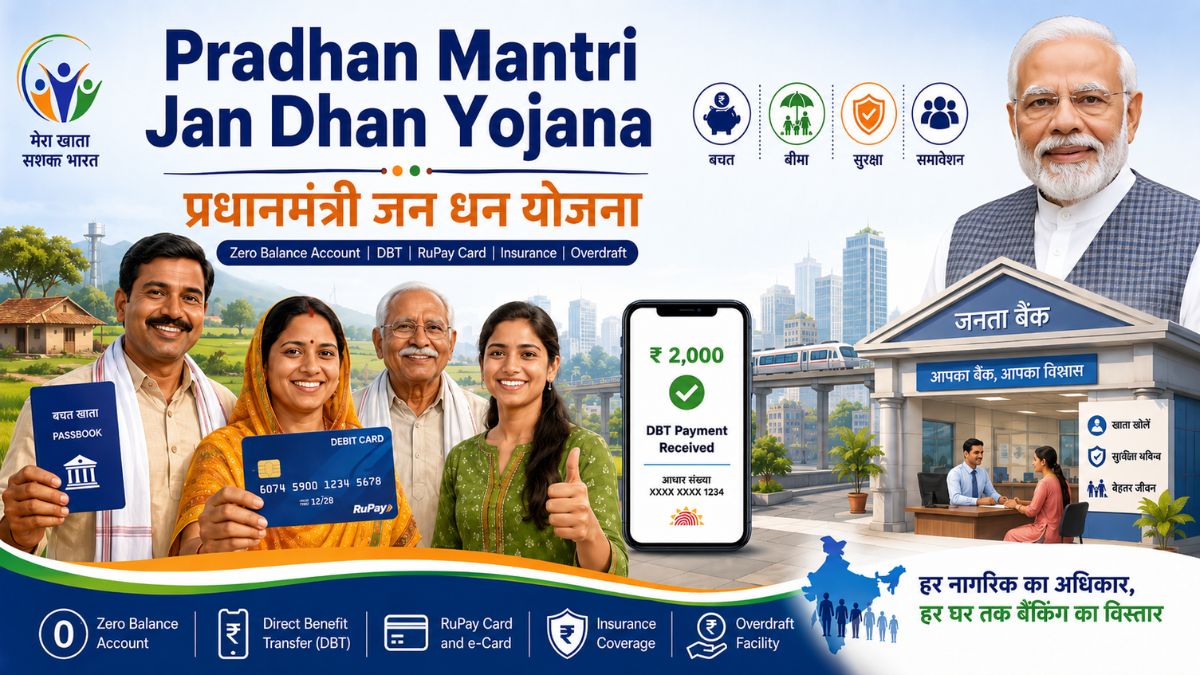
Pradhan Mantri Jan Dhan Yojana is again in search trends because people want to know its latest benefits, account rules, zero balance facility, RuPay card insurance, overdraft limit, and official account numbers. This article explains the scheme in simple English, with correct Hindi and English spelling, latest official figures, benefits, documents, and what account holders should do next.
What Happened?
Pradhan Mantri Jan Dhan Yojana, also called PMJDY, continues to be one of India’s biggest financial inclusion schemes. The scheme was launched to bring unbanked people into the formal banking system.
The latest official PMJDY dashboard shows that 58.30 crore beneficiaries have been banked so far. The total balance in beneficiary accounts is ₹300,579.58 crore. It also shows 13.55 lakh Bank Mitras providing branchless banking services across the country.
This means the scheme is not only about opening a bank account. It has become an important route for savings, Direct Benefit Transfer, insurance, pension access, RuPay debit card usage, and basic banking in rural and urban India.
Correct Name and Spelling
The correct English name is Pradhan Mantri Jan Dhan Yojana.
The correct Hindi name is प्रधानमंत्री जन धन योजना.
The official short form is PMJDY. In formal articles, it is better to use “Yojana,” not “Yojna,” because “Yojana” is the official English spelling used by the government.
What Is Pradhan Mantri Jan Dhan Yojana?
Pradhan Mantri Jan Dhan Yojana is a National Mission for Financial Inclusion. Its aim is to provide affordable access to banking and financial services. These services include a basic savings account, deposit facility, money transfer, credit, insurance, and pension.
Under this scheme, a basic savings bank deposit account can be opened at a bank branch or through a Business Correspondent, also known as Bank Mitra. The scheme is mainly meant for people who do not already have a bank account.
Key Benefits of PMJDY
One of the biggest benefits of PMJDY is that the account can be opened with zero balance. There is no need to maintain a minimum balance in a Jan Dhan account.
Account holders also earn interest on the money deposited in the account. This helps poor and low-income families keep their money safely in a bank instead of keeping cash at home.
A RuPay debit card is provided to PMJDY account holders. This card helps users withdraw money, make digital payments, and access insurance benefits linked with the card.
PMJDY account holders may also get accidental insurance cover. The accident insurance cover was ₹1 lakh earlier, and it was enhanced to ₹2 lakh for new PMJDY accounts opened after 28 August 2018, subject to scheme conditions.
Eligible account holders can also get an overdraft facility of up to ₹10,000. This is not free money. It is a small credit support given by the bank to eligible customers, usually after satisfactory operation of the account and subject to bank rules.
PMJDY and Direct Benefit Transfer
PMJDY accounts are important for Direct Benefit Transfer, also called DBT. Many government benefits, subsidies, and welfare payments can be sent directly to the beneficiary’s bank account.
This reduces the need for middlemen and helps eligible people receive money directly. PMJDY is also linked with the JAM system, which means Jan Dhan, Aadhaar, and Mobile. This system has helped India build a faster and more transparent benefit transfer network.
Latest Official PMJDY Numbers
The latest official PMJDY progress report shows strong growth in the scheme.
The total number of beneficiaries is 58.30 crore. Out of this, 45.53 crore beneficiaries are from rural and semi-urban bank branches. This shows that the scheme has a very strong reach outside big cities.
The report also shows 32.51 crore women beneficiaries. This is important because access to bank accounts helps women receive money directly, save safely, and use formal financial services.
The total deposits in PMJDY accounts are ₹300,579.58 crore. The number of RuPay debit cards issued to beneficiaries is 40.58 crore.
These figures show that Jan Dhan accounts are not just inactive accounts. A large amount of money is being held in these accounts, and the scheme continues to support India’s financial inclusion goals.
Who Can Open a PMJDY Account?
A person who does not have any other bank account can open a basic savings bank deposit account under PMJDY. The account can be opened at a bank branch or through a Bank Mitra outlet.
The account is useful for people from low-income families, rural households, workers in the informal sector, small vendors, daily wage workers, and people who need a simple bank account for savings and government benefit transfers.
If a person already has a regular bank account, they should check with the bank before applying, because PMJDY is mainly meant for unbanked persons.
Documents Required for PMJDY Account
If Aadhaar is available, the account can usually be opened through Aadhaar-based e-KYC. If the address has changed, banks may accept self-certification of the current address as per rules.
If Aadhaar is not available, the applicant may use officially valid documents such as Voter ID, Driving Licence, Passport, NREGA card, or other documents accepted by the bank under KYC rules.
If a person does not have standard documents but is considered low risk by the bank, the bank may allow a small account under applicable rules. Such accounts may have limits until full KYC is completed.
Why PMJDY Matters for India
PMJDY matters because access to a bank account is the first step toward financial security. Without a bank account, people may find it difficult to save money safely, receive government benefits, get insurance, use digital payments, or build a financial record.
For rural India, PMJDY has helped bring banking closer through Bank Mitras and branchless banking. For women, it has created a direct account in their own name. For the government, it has created a strong channel for DBT payments.
The scheme also helps promote digital payments because many account holders receive RuPay debit cards. Over time, this supports India’s move toward a more formal and digital financial system.
Impact on Women and Rural India
The impact of PMJDY is especially visible among women and rural users. A large share of Jan Dhan accounts belongs to women, and a major share of accounts are opened in rural and semi-urban areas.
This is important because many people in these areas were earlier outside the banking system. With a Jan Dhan account, they can receive money directly, keep savings in a bank, and access other financial products such as insurance and pension schemes.
For many families, a Jan Dhan account is also the first formal link with banks. This can later help them access other services, including small credit, insurance, and pension schemes.
Important Official Updates
The scheme remains active. There is no official information that PMJDY has been closed.
Account holders should keep their accounts active and complete KYC or re-KYC when the bank asks for it. Banks may contact account holders to update KYC details and reduce inoperative accounts.
There were reports earlier about inactive Jan Dhan accounts, but the government clarified that banks were not asked to close inactive PMJDY accounts in bulk. Account holders should still use their accounts regularly and follow bank instructions to avoid problems.
What Happens Next?
The next focus is likely to be account usage, KYC updates, digital payments, insurance coverage, pension enrolment, and better use of Jan Dhan accounts for welfare delivery.
People who already have PMJDY accounts should check whether their mobile number is linked, whether KYC is updated, and whether they have received their RuPay debit card. They should also understand the insurance and overdraft conditions instead of believing social media rumours.
People who still do not have a bank account can visit a nearby bank branch or Bank Mitra to ask about opening a PMJDY account.
Conclusion
Pradhan Mantri Jan Dhan Yojana is one of India’s most important government schemes for financial inclusion. It gives unbanked people access to a basic bank account, zero balance facility, RuPay card, insurance cover, overdraft support, and DBT benefits.
The latest official numbers show that PMJDY has reached crores of people, especially women and rural households. For account holders, the most important step now is to keep the account active, complete KYC when required, and understand the real benefits from official sources instead of rumours.
FAQ on Pradhan Mantri Jan Dhan Yojana
Is Pradhan Mantri Jan Dhan Yojana a zero balance account?
Yes. PMJDY accounts can be opened with zero balance. There is no requirement to maintain a minimum balance.
What is the accident insurance cover under PMJDY?
PMJDY account holders with a RuPay card can get accident insurance cover. The cover is ₹1 lakh for older eligible accounts and ₹2 lakh for new PMJDY accounts opened after 28 August 2018, subject to scheme conditions.
Can I get ₹10,000 overdraft from a Jan Dhan account?
Eligible PMJDY account holders may get an overdraft facility of up to ₹10,000. It depends on bank rules and satisfactory operation of the account.
Can I get ₹10,000 overdraft from a Jan Dhan account?
Eligible PMJDY account holders may get an overdraft facility of up to ₹10,000. It depends on bank rules and satisfactory operation of the account.
Is PMJDY only for rural people?
No. PMJDY is not only for rural people. It is for unbanked persons across India. However, the scheme has had a major impact in rural and semi-urban areas.
Can inactive Jan Dhan accounts be closed?
The government had clarified that banks were not asked to close inactive Jan Dhan accounts in bulk. But account holders should complete KYC or re-KYC when required and use the account regularly.
How can I open a PMJDY account?
You can visit a nearby bank branch or Bank Mitra outlet. Carry Aadhaar if available. If Aadhaar is not available, ask the bank about other accepted KYC documents.
