
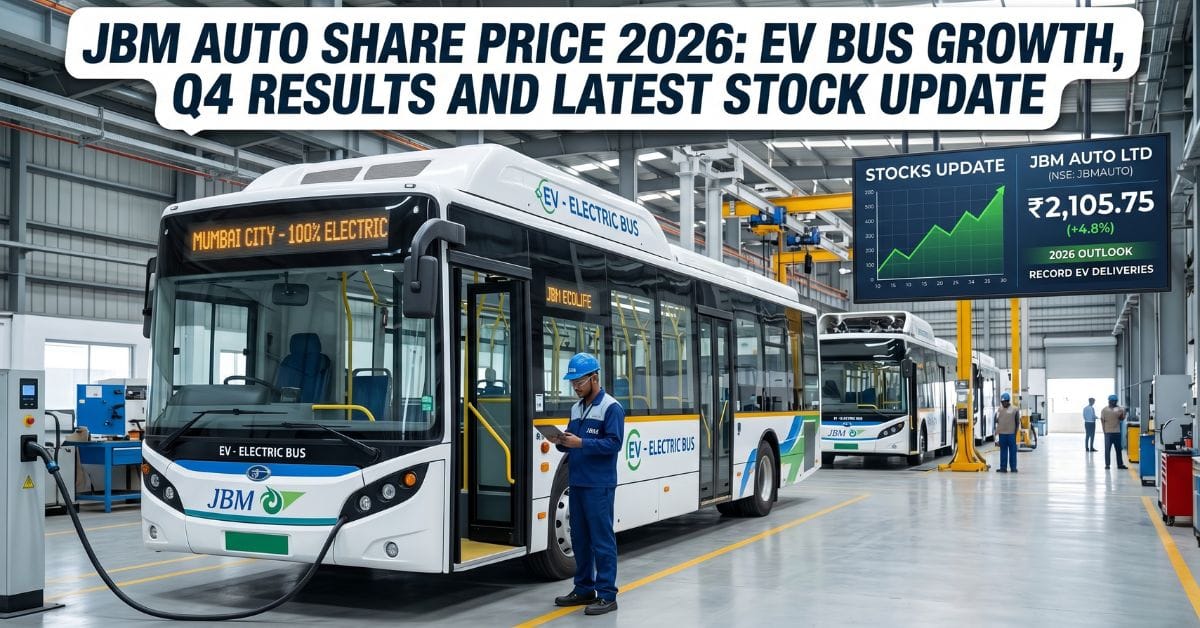
JBM Auto Share Price 2026 is in focus again as investors track the company’s electric bus growth, recent market share update, Q4 FY26 results, and fresh funding support for its EV mobility arm. The stock has become a key name in India’s electric public transport theme, especially after strong e-bus registration numbers and new investment news.
This article explains what happened, why JBM Auto shares are moving, the latest business updates, the company’s background, key risks, and what investors should watch next. This is only for information and should not be treated as investment advice.
What Happened JBM Auto Share Price 2026?
JBM Auto Share Price 2026 have attracted strong market attention in June 2026 after the company reported a major update in its electric bus business. The company said it became the top player in India’s electric bus segment in May 2026 with 49% market share, based on Vahan portal data.
The company also said it recorded 157 electric bus registrations in May 2026, which was the highest in the industry for that month. This update came after JBM Auto had already reported strong e-bus registrations in FY26.
The share price also got support from another major update. JBM Ecolife Mobility, the electric mobility arm of JBM Auto, secured a large investment from Motilal Oswal Alternates. The company said this capital will help it deploy more electric buses across India.
For investors, the main trigger is clear: JBM Auto is not being seen only as an auto component company anymore. The market is also looking at it as a strong electric mobility and public transport electrification player.
JBM Auto Share Price 2026: Latest Market Snapshot
As of 22 June 2026 afternoon market data, JBM Auto was trading near the ₹728 level. The stock’s 52-week range was around ₹477 to ₹790. This means the share has recovered strongly from its lower levels but is still below its 52-week high.
The latest price movement shows that investors are reacting to both earnings and future growth expectations. However, the stock has also become valuation-sensitive because the market is already giving importance to its EV bus growth story.
For short-term traders, important factors are volume, news flow, support levels, and market mood. For long-term investors, the bigger question is whether the company can convert its order book and market share into steady revenue, profit, and cash flow.
Key Details Behind the Stock Movement
Strong Electric Bus Market Share
JBM Auto said it achieved 49% market share in India’s electric bus segment in May 2026. The company also said its share increased from 33% in April to 49% in May in the current financial year-to-date period.
This matters because electric buses are becoming a major part of India’s public transport plans. State transport authorities, city transport bodies, airports, and private fleet operators are shifting towards cleaner mobility options.
JBM Auto’s electric bus portfolio includes city buses, intercity buses, school buses, staff buses, tarmac buses, luxury coaches, and special-purpose vehicles. This gives the company access to different demand segments.
Q4 FY26 Results Show Growth
JBM Auto reported growth in Q4 FY26. The company’s consolidated net profit rose year-on-year, and revenue from operations also increased. Its EBITDA also improved, showing better operating performance.
The board also recommended a final dividend for FY26. While dividend is not the main reason behind the stock’s current attention, it adds to overall investor interest.
The company also renamed its OEM division as “EV Business”, which shows that electric mobility is becoming a more central part of its business identity.
₹750 Crore Investment for E-Bus Deployment
A key fresh update is the ₹750 crore long-term strategic investment secured by JBM Ecolife Mobility from Motilal Oswal Alternates. The money is expected to support the rollout of more electric buses and strengthen sustainable public transport infrastructure.
The company said the investment will support deployment of around 2,000 additional e-buses. JBM Auto and JBM Ecolife together have a strong electric bus order book, and the group aims to expand its fleet further in the coming months.
This funding is important because electric bus deployment needs large capital. Buses, batteries, charging infrastructure, maintenance systems, and long-term service contracts all require strong financial support.
Background: What Does JBM Auto Do?
JBM Auto is part of the JBM Group and operates in the automotive and electric mobility space. The company has business interests in auto components, systems, electric vehicles, buses, EV aggregates, and related mobility solutions.
Earlier, many investors looked at JBM Auto mainly as an auto ancillary and manufacturing company. But in recent years, the electric bus segment has become a major growth driver.
The company’s EV bus business is linked to India’s larger push for clean public transport. With more cities facing pollution and traffic issues, electric buses are becoming important for government and private fleet operators.
JBM Auto has an integrated electric bus manufacturing facility in the NCR region. The company says this facility has an annual capacity of 20,000 electric buses. This scale is one reason why the market is closely tracking its execution.
Why It Matters for India
JBM Auto’s growth in electric buses matters because India is trying to reduce pollution from public transport. Diesel buses are still widely used in many cities. Electric buses can help reduce tailpipe emissions and improve air quality, especially in crowded urban areas.
India has also introduced schemes and policies to support electric mobility and e-bus adoption. Government-backed public transport electrification creates opportunities for companies that can manufacture, deploy, and maintain electric buses at scale.
If companies like JBM Auto execute well, the impact can be seen in several areas. Cities can get cleaner buses, transport departments can modernize fleets, and local manufacturing can get a boost. It can also create demand for batteries, charging systems, software, maintenance, and skilled jobs.
Impact on Indian Investors
For Indian investors, JBM Auto has become a stock linked to the EV and public mobility theme. The stock can benefit when the company reports strong order wins, higher registrations, better margins, or successful fleet deployment.
But investors should also be careful. A fast-rising stock can become expensive if earnings growth does not match market expectations. Electric bus contracts are large, but they can also involve execution challenges, working capital needs, payment cycles, and operational risks.
Investors should not look only at headlines like “market share” or “order book”. They should also track actual revenue conversion, profit margin, debt levels, cash flow, and return on capital.
Important Official Updates
The most important official update is the company’s press release on its May 2026 electric bus market share. JBM Auto said it recorded 157 electric bus registrations in May and achieved 49% market share in India’s electric bus segment.
Another important update is the investment in JBM Ecolife Mobility. The company said the funding from Motilal Oswal Alternates will help scale electric bus deployment across India.
JBM Auto also reported its Q4 FY26 earnings, where revenue and net profit grew year-on-year. The company also recommended a final dividend for FY26.
These updates are important because they show three things together: operating growth, market share strength, and funding support.
What Happens Next?
The next major thing to watch is execution. JBM Auto has a strong electric bus order book, but the market will want to see how quickly the company can deliver buses, deploy fleets, and convert orders into revenue.
Investors should also track future quarterly results. If revenue growth continues and margins improve, the stock may continue to remain in focus. But if execution slows or costs rise, the stock may face pressure.
Another factor is government policy. Electric bus tenders, state transport orders, charging infrastructure development, and subsidy timelines can affect the sector. Any delay in tenders or payments can impact companies working in public transport projects.
The stock may also remain sensitive to broader market conditions. If the overall market turns weak, even strong theme-based stocks can see profit booking.
Key Risks Investors Should Watch
The biggest risk is valuation. If a stock runs ahead of earnings, it can become risky even if the company has a good business story.
The second risk is execution. Electric bus deployment is not just about manufacturing buses. It also requires charging infrastructure, service support, route planning, and long-term operations.
The third risk is working capital. Large public transport projects can sometimes involve long payment cycles. Investors should watch cash flow closely.
The fourth risk is competition. India’s electric bus market has many players, and future tenders can become competitive on pricing and terms.
Expert View in Simple Words
JBM Auto’s share price in 2026 is being driven by the company’s EV bus growth story. The company has reported strong electric bus market share, better Q4 FY26 numbers, and fresh funding support for fleet expansion.
Read More : Number Plate History 2026
The long-term opportunity looks attractive because India is moving towards electric public transport. But the stock is not risk-free. Investors should focus on execution, profitability, debt, cash flow, and valuation before making any decision.
For now, JBM Auto remains one of the most closely watched EV bus-related stocks in India.
FAQs (JBM Auto Share Price 2026)
What is the main reason behind JBM Auto share price movement in 2026?
The main reason is strong investor interest in the company’s electric bus business. Its May 2026 market share update, Q4 FY26 results, and funding news have kept the stock in focus.
What was JBM Auto’s electric bus market share in May 2026?
JBM Auto said it had 49% market share in India’s electric bus segment in May 2026, based on Vahan portal data.
Is JBM Auto only an auto component company?
No. JBM Auto is also active in electric buses, EV mobility, and related automotive systems. Its EV bus business has become a major focus area.
Did JBM Auto report profit growth in Q4 FY26?
Yes. JBM Auto reported year-on-year growth in consolidated net profit and revenue in Q4 FY26.
Is JBM Auto share a good buy in 2026?
This depends on an investor’s risk profile, valuation comfort, and investment horizon. The company has a strong EV bus growth story, but investors should also check earnings, cash flow, debt, and execution risks. This article is not investment advice.
