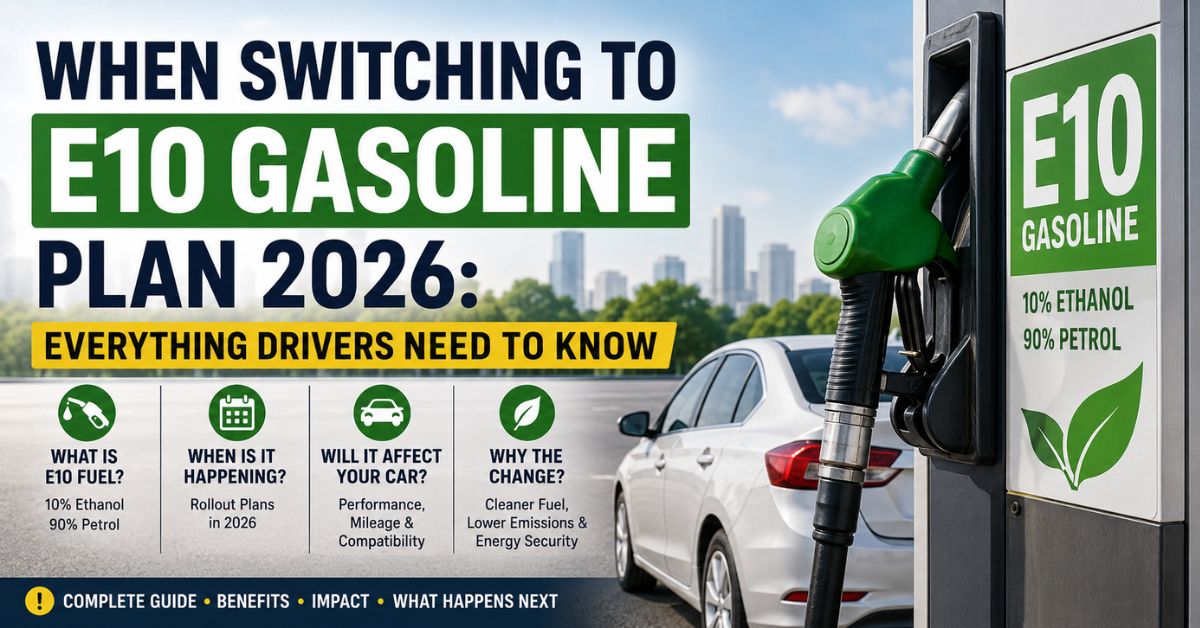
The move towardWhen Switching to E10 Gasoline Plan 2026 is becoming a major topic in several countries during 2026 as governments push cleaner fuels and lower carbon emissions. E10 fuel contains 10% ethanol and 90% petrol, making it one of the most widely used biofuel blends in the world. Many countries are now expanding ethanol-blended fuel programs to reduce dependence on imported crude oil and support renewable energy goals.
For consumers, the biggest questions are simple: What is E10 fuel, when is the switch happening, and will it affect vehicles, fuel prices, or mileage? Here is everything you need to know.
When Switching to E10 Gasoline Plan 2026 ?
E10 gasoline is a fuel blend that contains up to 10% ethanol mixed with regular petrol. Ethanol is usually produced from crops such as sugarcane, corn, or other biomass sources.
Governments support ethanol blending because it can help:
- Reduce greenhouse gas emissions
- Lower dependence on imported oil
- Support domestic agriculture and biofuel industries
- Improve energy security
E10 has already been used in many countries for years and is generally considered compatible with most modern petrol vehicles.
Why Are Countries Moving Toward E10 in 2026?
The global push for cleaner transportation fuels is one of the biggest reasons behind the shift.
Several governments have announced new biofuel roadmaps during 2025 and 2026. Vietnam, for example, has officially rolled out E10 gasoline nationwide from June 1, 2026, replacing conventional unleaded gasoline with ethanol-blended fuel. Officials say the move is aimed at reducing emissions and encouraging renewable energy use.
Many countries view ethanol blending as a practical way to lower emissions without requiring consumers to immediately switch to electric vehicles.
India’s Ethanol Journey Is Already Moving Beyond E10
When Switching to E10 Gasoline Plan 2026 many countries are discussing E10 adoption, India has already moved further ahead.
The Indian government has achieved 20% ethanol blending in petrol and has introduced nationwide E20 fuel availability. New proposals are also being discussed for higher ethanol blends such as E85 and E100 for specially designed flex-fuel vehicles.
The Ministry of Petroleum and Natural Gas has directed oil companies to sell petrol blended with up to 20% ethanol across India from April 2026 under updated regulations.
This means Indian consumers are already experiencing a transition that goes beyond the E10 stage.
Will E10 Fuel Affect Vehicle Performance?
For most modern petrol vehicles, E10 fuel generally works without major modifications.
However, ethanol has different properties than pure petrol. Because ethanol contains less energy per litre, some drivers may notice a small reduction in fuel economy.
The impact usually depends on:
Vehicle age
Newer vehicles are typically designed to handle ethanol-blended fuels more effectively.
Engine design
Manufacturers often tune modern engines to work efficiently with ethanol blends.
Driving conditions
City driving, highway use, and climate can influence overall fuel efficiency.
In countries that have used E10 for years, the effect on everyday driving is generally considered minor.
Concerns Raised by Vehicle Owners
The transition to higher ethanol blends has created debate among vehicle owners and automobile enthusiasts.
Read More : New Tata Tiago Facelift 2026 Launched in India
Online discussions in automotive communities show concerns about mileage, engine wear, fuel system components, and long-term maintenance costs, especially for older vehicles that were originally designed for lower ethanol blends.
Experts note that E10 is usually less demanding than higher blends such as E20, E85, or E100. Vehicles specifically engineered for ethanol-blended fuel tend to perform better with these fuels.
Consumers are encouraged to check their vehicle manufacturer’s recommendations before using any higher ethanol blend.
How Does E10 Compare With E20?
| Feature | E10 | E20 |
|---|---|---|
| Ethanol Content | 10% | 20% |
| Petrol Content | 90% | 80% |
| Vehicle Compatibility | Very high | Best with E20-compatible vehicles |
| Fuel Economy Impact | Usually small | Can be slightly higher |
| Emission Reduction | Moderate | Greater than E10 |
Many countries start with E10 before gradually increasing ethanol content as vehicle technology and fuel infrastructure improve.
When Switching to E10 Gasoline Plan 2026 Fuel Industry Supports Ethanol Blending
Fuel companies and policymakers argue that ethanol blending offers several long-term advantages.
These include:
- Reduced oil import bills
- Increased demand for agricultural products
- Better energy security
- Lower carbon emissions from transport
For countries that import large amounts of crude oil, ethanol can become an important part of national energy strategy.
What Happens Next?
The future of ethanol-blended fuel is likely to involve higher blend levels rather than a return to pure petrol.
India is already exploring E85 and E100 fuel standards for flex-fuel vehicles. Other countries are beginning nationwide E10 programs and may eventually expand to higher blends as technology develops.
Automakers are also investing in engines designed to operate efficiently with multiple fuel types, including ethanol-rich blends.
As governments continue to focus on cleaner transportation, ethanol is expected to remain an important part of fuel policy over the next decade.
FAQs (When Switching to E10 Gasoline Plan 2026)
What does E10 gasoline mean?
E10 gasoline contains 10% ethanol and 90% petrol.
Is E10 fuel safe for cars?
Most modern petrol vehicles can safely use E10 fuel. Drivers should still check their vehicle manufacturer’s recommendations.
Does E10 reduce mileage?
E10 may cause a small reduction in fuel economy because ethanol contains less energy than petrol, but the difference is usually limited.
Is India switching to E10 in 2026?
India has already moved beyond E10 and is implementing E20 fuel nationwide while exploring higher ethanol blends such as E85 and E100.
Why are governments promoting ethanol fuel?
The main goals are reducing emissions, lowering oil imports, improving energy security, and supporting domestic agriculture.
Will E10 fuel replace petrol completely?
E10 is still petrol-based fuel. It does not replace petrol entirely but blends ethanol with conventional gasoline.